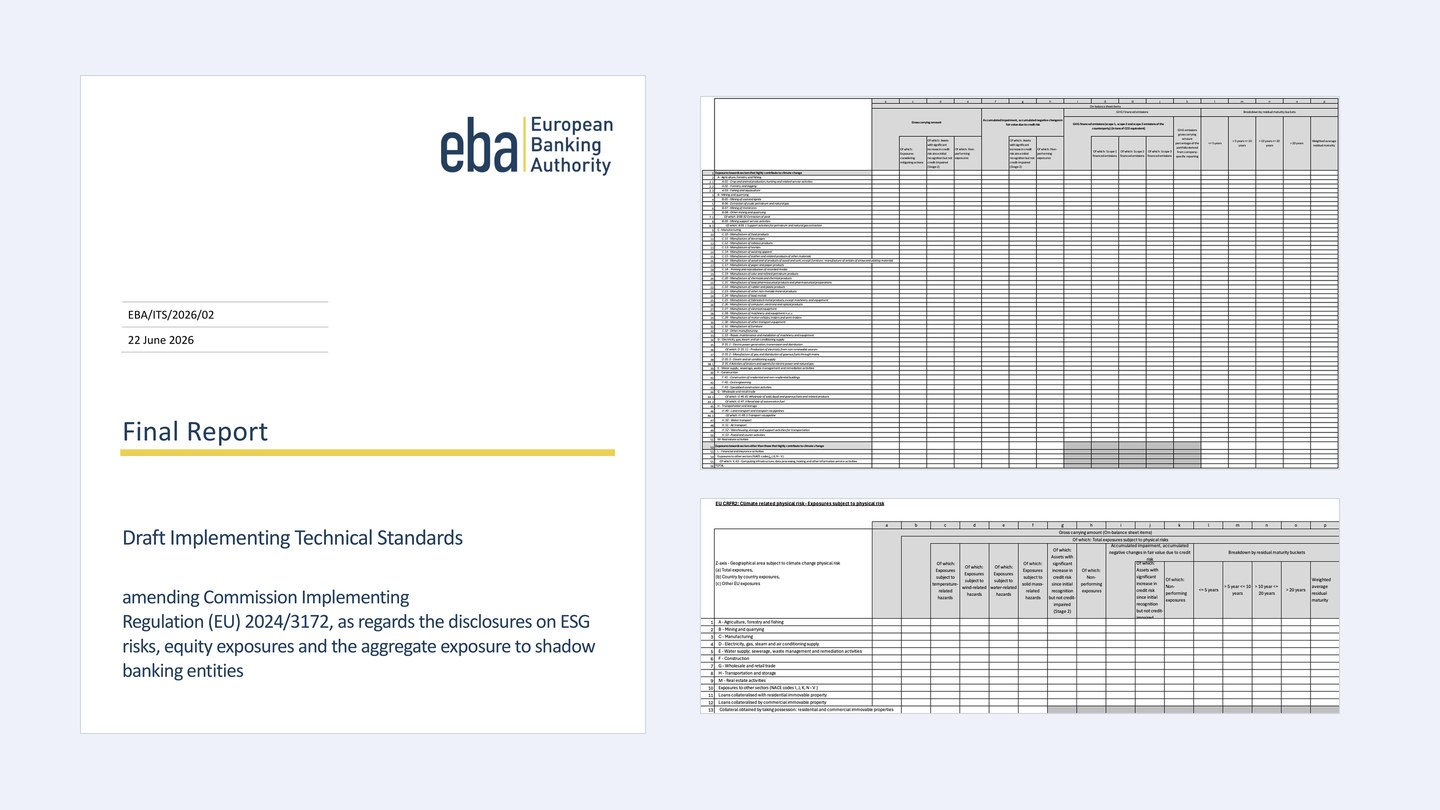
This is a practical walkthrough of where ESG requirements sit in the Basel framework, the key documents that translate those requirements into binding rules, the timeline for application, and the largest implementation challenges banks face. It covers the Basel context, key documents, timeline, EBA ESG Guidelines, Pillar 3 ESG templates and implementation challenges.
Prudentially, ESG requirements reside in Pillars 2 and 3 of the Basel framework
| Basel Framework (the bank capital rulebook) | Pillar 1: Minimum Capital | Pillar 2: Supervisory Review | Pillar 3: Market Discipline |
|---|---|---|---|
| General Basel purpose | Banks must hold minimum capital against credit, market, and operational risks. | Banks run internal risk assessments (ICAAP) to assess risks not captured in Pillar 1. Supervisors evaluate adequacy. | Banks must publicly disclose risk exposures and capital adequacy to enable market oversight. |
| EU ESG regulation | No ESG-specific capital rules in force. Green Supporting Factor and Brown Penalising Factor have been discussed but currently not topical. | General capital regulationCRR 3CRD 6Binding ESG implementation rulebooksEBA Guidelines on ESG Risk ManagementEBA Guidelines on Environmental Scenario Analysis | Pillar 3 ESG TemplatesAdjacent disclosure (but not prudential) regulationsEU Taxonomy regulationCSRDSFDR |
Pillar 1 covers minimum capital: banks must hold minimum capital against credit, market, and operational risks. Pillar 2 covers supervisory review: banks run internal risk assessments (ICAAP) to assess risks not captured in Pillar 1, and supervisors evaluate adequacy. Pillar 3 covers market discipline: banks must publicly disclose risk exposures and capital adequacy to enable market oversight.
On EU ESG regulation: there are no ESG-specific capital rules in force in Pillar 1. A Green Supporting Factor and Brown Penalising Factor have been discussed but are currently not topical. Pillar 2 contains the binding ESG implementation rulebooks, anchored in CRR 3 and CRD 6 as the general capital regulation, with the EBA Guidelines on ESG Risk Management and the EBA Guidelines on Environmental Scenario Analysis as the binding ESG-specific texts. Pillar 3 covers the Pillar 3 ESG Templates, alongside adjacent disclosure regulations such as the EU Taxonomy regulation, CSRD and SFDR.
EBA Guidelines and Pillar 3 templates outline the concrete expectations
| EBA Guidelines on ESG Risk Management | EBA Guidelines on Environmental Scenario Analysis | Pillar 3 ESG Disclosure | |
|---|---|---|---|
| Purpose | Sets expectations for internal identification, measurement, management and monitoring of ESG risks as well as transition planning. | Sets expectations for stress-testing resilience to environmental shocks and assessing long-term business model viability. | Sets standardized templates for public disclosure on climate risk exposures, enabling market participants to compare and scrutinize them. |
| In practice | Build internal capabilities to assess ESG risks at counterparty and portfolio level, embed them into everyday risk management, and set quantitative targets for managing them over time. | Run forward-looking analyses using climate scenarios to test whether capital, liquidity and the business model can withstand environmental shocks. | Collect data from counterparties, aggregate it, and fill and publish the standardized templates. |
The EBA Guidelines on ESG Risk Management set expectations for internal identification, measurement, management and monitoring of ESG risks as well as transition planning. In practice, banks need to build internal capabilities to assess ESG risks at counterparty and portfolio level, embed them into everyday risk management, and set quantitative targets for managing them over time.
The EBA Guidelines on Environmental Scenario Analysis set expectations for stress-testing resilience to environmental shocks and assessing long-term business model viability. In practice, banks need to run forward-looking analyses using climate scenarios to test whether capital, liquidity and the business model can withstand environmental shocks.
The Pillar 3 ESG Disclosure templates set standardized templates for public disclosure on climate risk exposures, enabling market participants to compare and scrutinize them. In practice, banks need to collect data from counterparties, aggregate it, and fill and publish the standardized templates.
New requirements entering into force in steps during 2026 and 2027
| 2026 | 2027 | |
|---|---|---|
| EBA Guidelines on ESG Risk Management | ApplicationLargeOther | ApplicationSNCI |
| EBA Guidelines on Environmental Scenario Analysis | ApplicationFormal assessmentLargeOtherSNCI | |
| CRD6 Transition Plans (part of EBA ESG risk GLs) | ApplicationInformal dialogueLargeOther | ApplicationFormal assessmentLargeOtherSNCI |
| Pillar 3 ESG Templates | Already in forceTemplate updateLarge | ApplicationRevised templatesLargeOtherSNCI |
EBA Guidelines on ESG Risk Management were published in 2025; application starts in 2026 for Large and Other institutions, and in 2027 for SNCIs. The EBA Guidelines on Environmental Scenario Analysis were published in 2026; application and formal assessment for all institutions follows in 2027. CRD6 Transition Plans (part of the EBA ESG risk Guidelines) move from informal dialogue during application in 2026 to formal assessment in 2027. Pillar 3 ESG Templates are already in force for Large institutions, with a template update in 2026 and application of the revised templates for all institutions in 2027.
EBA ESG Guidelines require institution-wide internal ESG risk management competencies and processes
| Topic | Description | Requirements by institution size | ||
|---|---|---|---|---|
| Large (>EUR 30bn) | Other | SNCI (<EUR 5bn) | ||
| Materiality assessment§4.1 | ESG risk materiality across all financial risk categories and ≥10-year horizon. | Full | Full | FullEvery 2 years |
| Data & measurement methodologies§4.2 | ESG data collection. Risk measurement using exposure-based, sector-based, portfolio alignment and scenario-based methods. | Full | Proportionate | Simplified |
| Strategy & business models§5.2 | ESG risk impact on business model viability, revenue sources and strategic objectives. | Full | Full | Full |
| Risk appetite§5.3 | ESG-related KRIs, limits, thresholds and exclusions. | Full | Full | Full |
| Internal culture & controls§5.4 | Three lines of defence, staff training, management body ESG competence, internal audit coverage. | Full | Full | Full |
| ICAAP & ILAAP§5.5 | Material ESG risks in capital and liquidity adequacy assessment. | Full | Full | Full |
| Financial risk category policies§5.6 | ESG integration into credit, market, liquidity, operational/reputational and concentration risk policies. | Full | Full | Full |
| Monitoring & internal reporting§5.7 | Backward- and forward-looking ESG metrics. | Full | Simplified | Simplified |
| Transition plans§6 | Plans with quantitative targets, milestones, governance, implementation roadmap and counterparty engagement strategy. | Full | Core elements | Core elements |
The Guidelines cover nine areas. Materiality assessment (§4.1) requires ESG risk materiality across all financial risk categories and a ≥10-year horizon: Full for Large and Other institutions, and Full but every 2 years for SNCIs. Data & measurement methodologies (§4.2) requires ESG data collection and risk measurement using exposure-based, sector-based, portfolio alignment and scenario-based methods: Full for Large, Proportionate for Other, Simplified for SNCIs. Strategy & business models (§5.2) requires assessing ESG risk impact on business model viability, revenue sources and strategic objectives: Full across all institution sizes.
Risk appetite (§5.3) requires ESG-related KRIs, limits, thresholds and exclusions: Full across all institutions. Internal culture & controls (§5.4) requires three lines of defence, staff training, management body ESG competence, and internal audit coverage: Full across all institutions. ICAAP & ILAAP (§5.5) requires material ESG risks in capital and liquidity adequacy assessment: Full across all institutions. Financial risk category policies (§5.6) requires ESG integration into credit, market, liquidity, operational/reputational and concentration risk policies: Full across all institutions. Monitoring & internal reporting (§5.7) requires backward- and forward-looking ESG metrics: Full for Large institutions, Simplified for Other and SNCIs. Transition plans (§6) require plans with quantitative targets, milestones, governance, implementation roadmap and counterparty engagement strategy: Full for Large institutions, Core elements for Other and SNCIs.
Pillar 3 calls for quantitative climate disclosures on the banking book, detail depends on institution size
| Template | Description | Requirements by institution size | ||
|---|---|---|---|---|
| Large (>EUR 30bn) | Other listed + Large subsidiaries | SNCI and other non-listed | ||
| Qualitative information | ESG risk integration into strategy, governance, risk management and metrics. | Full | Full | SimplifiedTable 1A |
| Template 1: Credit quality by sector | Financed emissions by sector (NACE), credit quality and maturity. | FullSemi-annual | FullAnnual | SimplifiedTemplate 1A |
| Template 2: Energy performance of immovable property collateral | Real estate energy performance by property type, EPC label and data source. | FullSemi-annual | FullAnnual | |
| Template 3: Emission intensity per physical output and by sector | GHG intensities for high-climate-impact sectors versus Paris-aligned pathways. | FullAnnual | ||
| Template 4: Exposures to top 20 carbon-intensive firms | Lending exposure to the globally top 20 largest emitters. | FullSemi-annual | ||
| Template 5: Exposures subject to physical risk | Exposure to temperature, wind, water and solid mass-related hazards by geography. | FullSemi-annual | Simplified (5A)Annual | SimplifiedTemplate 1A |
| Templates 6–9.3: GAR and BTAR | Taxonomy-eligible and taxonomy-aligned exposures (GAR and BTAR). | FullAnnual | ||
| Template 10: Assets contributing to sustainability and transition financing | Green, sustainability, sustainability-linked and transition financing by instrument type. | FullAnnual | ||
Qualitative information covers ESG risk integration into strategy, governance, risk management and metrics: Full for Large and Other listed + Large subsidiaries, and Simplified (Table 1A) for SNCIs and other non-listed. Template 1 (Credit quality by sector) covers financed emissions by sector (NACE), credit quality and maturity: Full and semi-annual for Large, Full and annual for Other, and Simplified (Template 1A) for SNCIs. Template 2 (Energy performance of immovable property collateral) covers real estate energy performance by property type, EPC label and data source: Full and semi-annual for Large, Full and annual for Other.
Template 3 (emission intensity per physical output and by sector) covers GHG intensities for high-climate-impact sectors versus Paris-aligned pathways: Full and annual for Large institutions only. Template 4 (Exposures to top 20 carbon-intensive firms) covers lending exposure to the globally top 20 largest emitters: Full and semi-annual for Large institutions only. Template 5 (Exposures subject to physical risk) covers exposure to temperature, wind, water and solid mass-related hazards by geography: Full and semi-annual for Large, Simplified (5A) and annual for Other, Simplified (Template 1A) for SNCIs. Templates 6–9.3 (GAR and BTAR) cover taxonomy-eligible and taxonomy-aligned exposures: Full and annual for Large institutions only. Template 10 (Assets contributing to sustainability and transition finance) covers green, sustainability, sustainability-linked and transition financing by instrument type: Full and annual for Large institutions only.