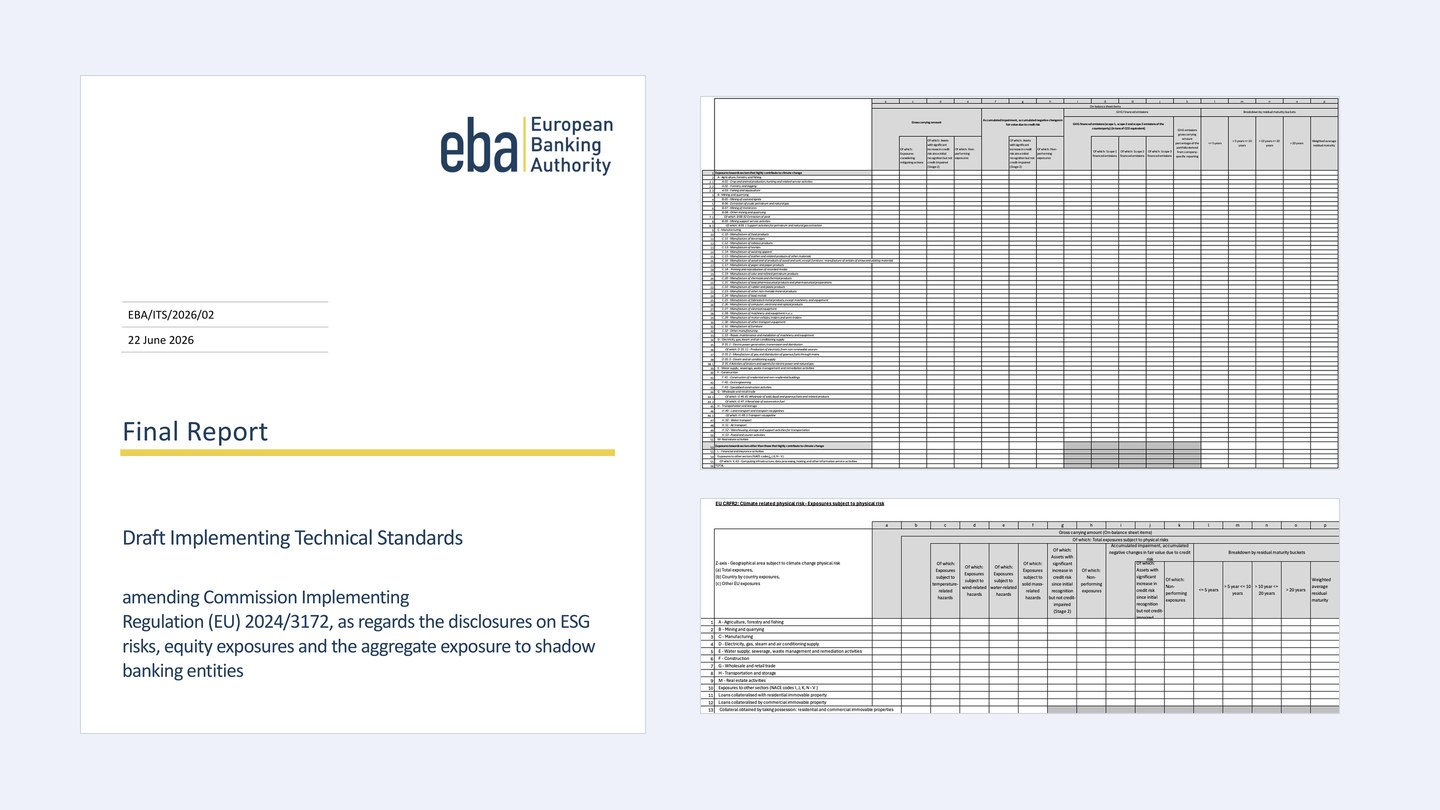
In June 2026 the European Banking Authority (EBA) published the final Pillar 3 ESG templates and the implementing technical standards that go with them. The legislative process should make these official in time to apply from year end 2026, a year later for small and non-complex institutions. Pillar 3 ESG disclosure becomes much more widespread, and somewhat simpler for large institutions.
In this article we discuss the corporate data needs that arise from the templates this regulation mandates. See the official EBA ITS text and our practical intro to prudential ESG requirements for some context from our prior blog post.
Overview of all Pillar 3 ESG templates
| Template | Who reports it | Purpose | Main data need |
|---|---|---|---|
| EU CRFRA | Large institutions, other listed | How environmental risk, including climate, is built into strategy, governance and risk management. | Process data |
| Table 2 | Large institutions, other listed | How social risk is built into strategy, governance and risk management. | Process data |
| Table 3 | Large institutions, other listed | How governance risk is built into strategy, governance and risk management. | Process data |
| Table 1A | Other non-listed institutionsSNCIs are exempt | A short-form version of the three tables above, covering E, S and G together. | Process data |
| EU CRFR1 | Large institutions, other listed, large subsidiaries | Exposures, financed emissions and mitigation share by high climate impact sector. | Company dataMore detail below |
| EU CRFR1.1 | SNCIs and other non-listed institutions | Transition and physical risk in one simplified template, by sector and top four countries. | Company and collateral asset dataNo emissions |
| EU CRFR2 | Large institutions | Exposures in locations exposed to climate-related physical hazards, by hazard type and country. | Company and collateral asset dataMore detail below |
| EU CRFR2.1 | Other listed institutions and large subsidiaries | The same as EU CRFR2, without the hazard type split and with two maturity buckets. | Company and collateral asset dataMore detail below |
| EU CRFR3 | Large institutions, other listed, large subsidiaries | Energy performance of immovable property collateral, by EPC label and data source. | Collateral asset data |
| EU CRFR4 | Large institutions only | Emission intensity per unit of physical output against the IEA net zero pathway. | Company dataMore detail below |
| EU Template 10 | Large institutions only | Exposures that contribute to sustainability objectives, and transition finance. | Company and collateral asset data based on self-defined criteria |
EU CRFR1: transition risk, by sector
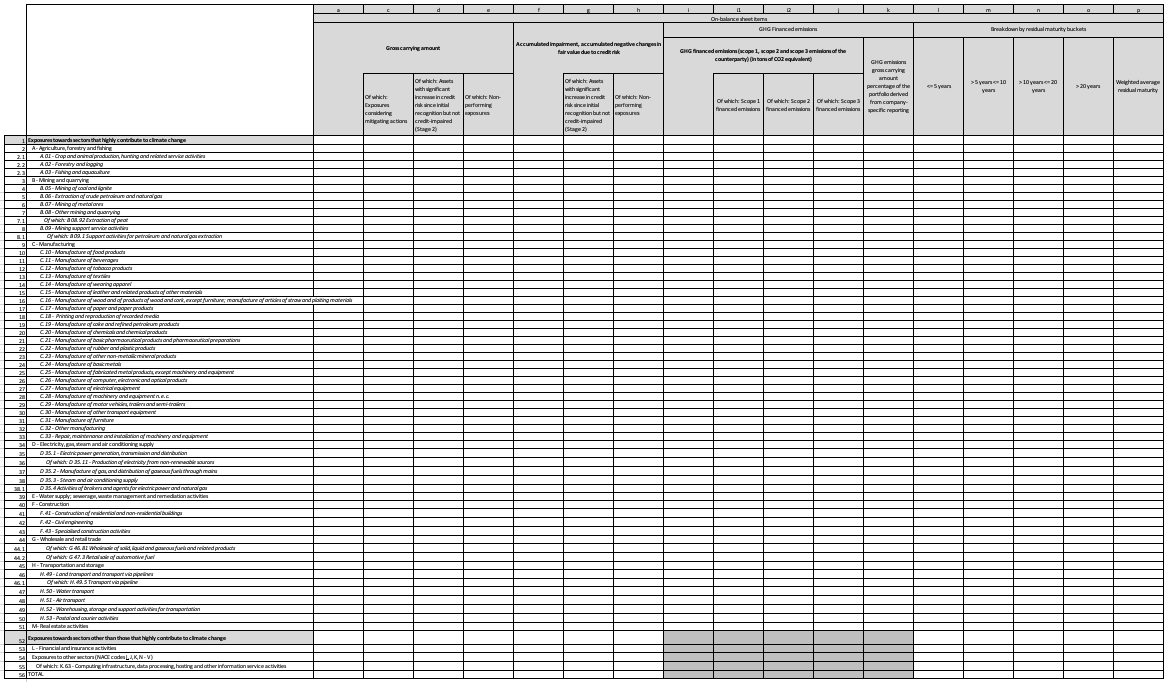
Financed emissions for high climate impact sectors.
It largely resembles the old Template 1, renamed after the Basel Committee’s template of the same name and reworked mainly in its sector breakdown.
CRFR1 reports exposures, financed emissions and climate change mitigation share by high climate impact sector, alongside credit quality (IFRS 9 stage 2, non-performing status, accumulated impairment) and residual maturity. Rows are NACE sectors, with the fossil fuel sectors broken out.
| Dataset | What the template needs |
|---|---|
| Company’s NACE code | The direct counterparty’s, not the holding company’s. Where the borrower is a holding company or an SPV, the sector of the entity that receives the funding applies. Down to the four-digit class in places, to isolate fossil fuel activities. |
| Climate change mitigation share | Company or instrument level, for example a green loan. From EU Taxonomy alignment or another self-defined criteria set, the same basis as Template 10. |
| Reported Scope 1, 2 and 3 GHG emissions | Where reported emissions are missing, estimate from sector-specific physical or economic activity intensities. The share of the portfolio covered by company reporting is itself disclosed. |
| EVIC / total liabilities and equity | For PCAF attribution factors, which scale a counterparty’s emissions to the bank’s share of its financing. |
EU CRFR2: physical risk, by sector and country
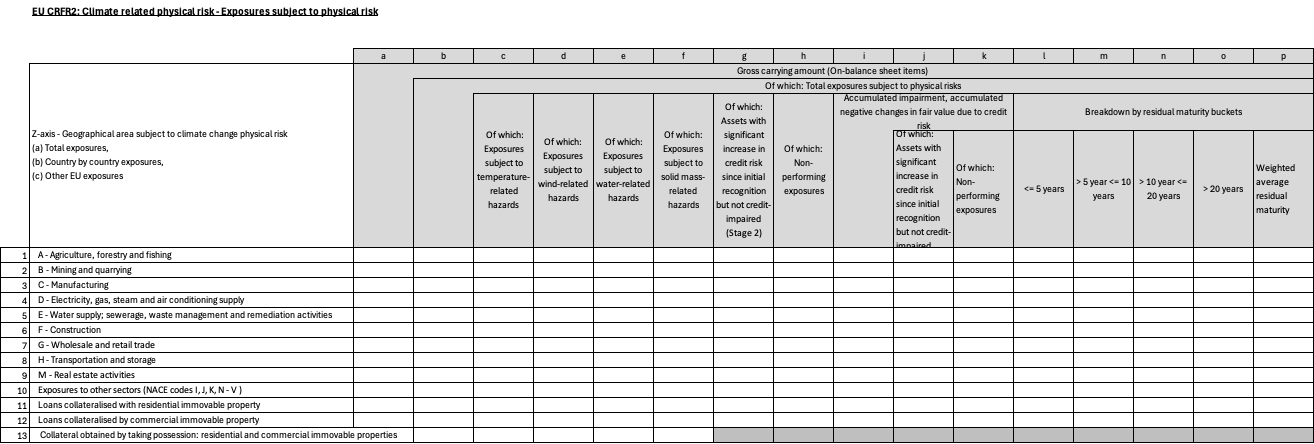
Banking book exposure to temperature, wind, water and solid mass-related hazards, by industry and country.
It largely resembles the old Template 5, with the acute and chronic split replaced by four hazard types.
CRFR2 reports exposures subject to physical risk by hazard type and sector, with a separate table for each country where the institution has material exposure. Rows are NACE sections A to H and M, then property collateral.
“Institutions shall ensure that the identification and assessment of exposures subject to climate-related physical risk are conducted at the highest possible level of geographical granularity (i.e. using precise geolocalisation of counterparties’ assets and activities) and, at a minimum, at NUTS level 3.”
| Dataset | What the template needs |
|---|---|
| Geolocation of key assets or collateral | The geolocation of the company’s key assets. The ITS leans on the EBA ESG Risk Management Guidelines, already required under CRD Article 87a: location of counterparties’ assets and activities, their hazard exposure, and the availability of insurance. |
| Hazard exposure by hazard type | Temperature, wind, water and solid mass, the EU Taxonomy classification. The ITS says to use data from Union bodies and national authorities, and names ten public sources including the DRMKC Risk Data Hub, the IPCC Interactive Atlas and Copernicus. |
| Company’s NACE code | The direct counterparty’s again, at section level only: A to H, M, and other sectors. |
EU CRFR2.1: physical risk, simplified
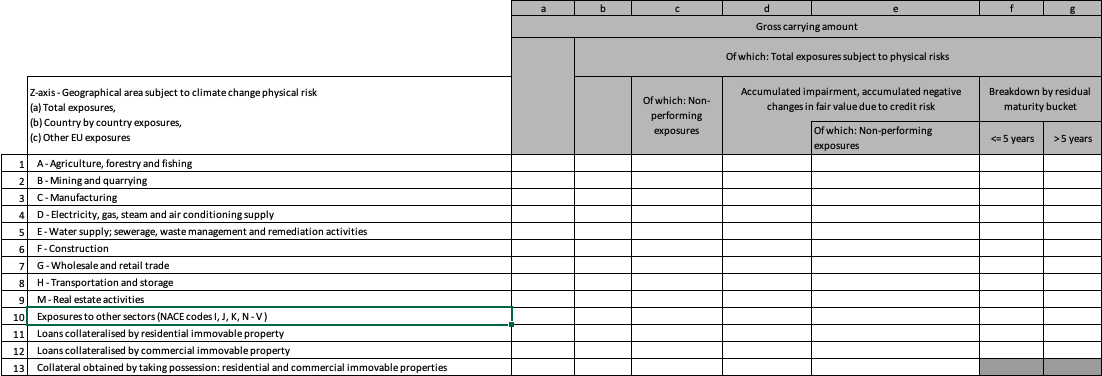
Banking book exposure to physical climate hazards, by industry and country.
It covers the same exposures as CRFR2, with fewer columns. It is a new template with no predecessor, filed once a year by other listed institutions and large subsidiaries.
CRFR2.1 reports exposures subject to physical risk by sector, with a separate table for each country where the institution has material exposure. Rows are the same as CRFR2: NACE sections A to H and M, then property collateral.
“Institutions shall ensure that the identification and assessment of exposures subject to climate-related physical risk are conducted at the highest possible level of geographical granularity (i.e. using precise geolocalisation of counterparties’ assets and activities) and, at a minimum, at NUTS level 3.”
| Dataset | What the template needs |
|---|---|
| Geolocation of key assets or collateral | The geolocation of the company’s key assets. The ITS leans on the EBA ESG Risk Management Guidelines, already required under CRD Article 87a: location of counterparties’ assets and activities, their hazard exposure, and the availability of insurance. |
| Hazard exposure | Only whether the location is exposed, with no breakdown by hazard type. The ITS says to use data from Union bodies and national authorities, and names ten public sources including the DRMKC Risk Data Hub, the IPCC Interactive Atlas and Copernicus. |
| Company’s NACE code | The direct counterparty’s again, at section level only: A to H, M, and other sectors. |
EU CRFR4: emission intensity against the IEA net zero pathway
Sectoral alignment metrics for high-emitting sectors.
It is the old Template 3 on alignment metrics, now with a prescribed metric for each sector and explicit IEA targets.
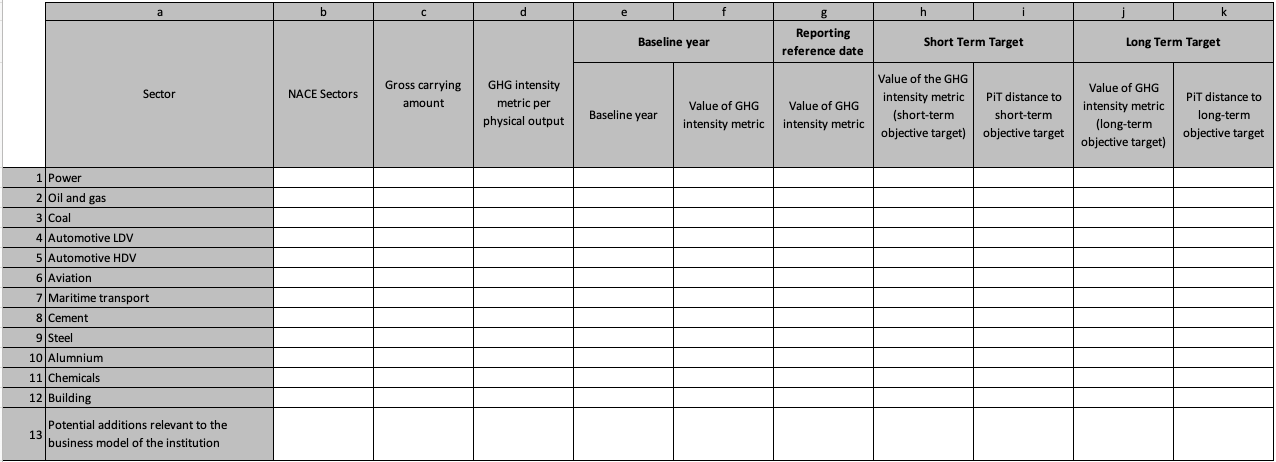
CRFR4 reports emission intensity per unit of physical output for twelve IEA sectors, against a baseline year, the reporting date, and short and long term targets, with the point-in-time distance to each as a percentage. The targets are IEA Net Zero Emissions by 2050 values at reporting year plus three and at 2050, not the institution’s own.
| Dataset | What the template needs |
|---|---|
| GHG intensity per physical output | As reported by the company, or calculated from absolute CO2 emissions and physical output. Scope and metric are prescribed per sector and should be converted to the specific sectoral units (see table below). |
| IEA NZE2050 scenario metrics | The IEA Net Zero Emissions by 2050 value for each sector, at reporting year plus three and at 2050. |
| Turnover by activity | Where use of proceeds is unknown, the gross carrying amount is allocated across sectors and metrics by the counterparty’s activity distribution, including turnover by activity. |
Scope 1 covers the industrial sectors, where emissions sit in the production process; scope 3 covers fuel and mobility, where what matters is combustion downstream of the manufacturer.
| Sector | Emission scope | Metric |
|---|---|---|
| Power | Scope 1 | t CO2 / GWh |
| Oil and gas | Scope 3 | t CO2 / EJ |
| Coal | Scope 3 | t CO2 / EJ |
| Automotive LDV | Scope 3 (car maker) | t CO2 / pkm |
| Automotive HDV | Scope 3 (truck maker) | t CO2 / tkm |
| Aviation | Scope 3 (plane maker), Scope 1 (airlines) | t CO2 / pkm |
| Maritime transport | Scope 3 (ship maker), Scope 1 (ship owner) | t CO2 / tkm |
| Cement | Scope 1 | t CO2 / t of cement |
| Steel | Scope 1 | t CO2 / t of steel |
| Aluminium | Scope 1 | t CO2 / t of aluminium |
| Chemicals | Scope 1 | t CO2 / t of chemicals |
| Building | Scope 1 and 2 | t CO2 / m² |
EU Template 10: mitigating actions
Environmentally sustainable or transition-supporting financing.
It keeps its old number but not its old shape: it grew from 6 data points to 160 when the GAR and BTAR templates were deleted and it took over their role.
Template 10 reports exposures by instrument and counterparty, split by climate change mitigation, adaptation and other environmental objectives. Rows separate assets that mitigate transition and physical risks from assets that finance the transition, a dedicated block that marks the arrival of transition finance in prudential disclosure.

The one dataset it needs is each exposure’s contribution to sustainability objectives, judged against criteria the institution chooses itself and has to name in the narrative and in column (e). The EU Taxonomy needs alignment data at company level; Green Loan Principles need it at instrument level.
| Qualifying criteria | Source |
|---|---|
| EU Taxonomy | Regulation (EU) 2020/852 criteria |
| The institution’s own criteria | Defined, applied and described by the reporting institution |
| Green Loan Principles | LMA, APLMA and LSTA |
| Sustainability-Linked Loan Principles | LMA, APLMA and LSTA |
| Guide to Transition Loans | LMA, APLMA and LSTA |
| Green Bond Principles | ICMA |
| Energy Efficiency Mortgage Initiative | Standards for mortgage loans |
| Commission Recommendation (EU) 2023/1425 | On facilitating finance for the transition to a sustainable economy |
How Klever maps to the Pillar 3 ESG template disclosures
Strip out the aggregation and the credit quality columns, which a bank fills from its own books, and what remains is a short list of things it has to know about each corporate borrower: what it does, what it emits, what it is worth, and where its assets are.
| Template | What corporate data is needed | Klever coverage |
|---|---|---|
| EU CRFR1 | Scope 1, 2 and 3 emissions · EVIC · Climate change mitigation share | Company matchingReported datapoints |
| EU CRFR2 | Geolocation of key assets · Hazard exposure | Company matchingKey assets |
| EU CRFR4 | GHG intensity per physical output · Turnover by activity | Company matchingReported datapoints |
| EU Template 10 | Qualifying activity · Environmental objective supported | Not applicable |
The templates are final and the first reference date is 31 December 2026. Most of the work between now and then is data work: resolving counterparties, sourcing emissions and intensity metrics, and locating assets. If you are scoping that for your portfolio, we would be glad to talk it through.